Tuesday, November 20, 2012

Dead Bugs for Abs

The Core Training for Smart Folks article found in the Good Reads section lists one of my few staple abdominal exercises: the dead bug. It's great for getting the pelvis tilted backwards [posterior pelvic tilt] for those with poor posture [anterior pelvic tilt] and creates stronger abs.

The article lists a set of progressions from beginner to advanced strength levels but I've found it to be a rather large difficulty jump in certain variations or outright awkward. I've played around with reps, sets, tempo, and ankle weights which has proven to help. However after extended use it can become a stale exercise.

Fortunately Sarah Rippel has created a video demonstrating other variations and progressions of the dead bug exercise. (More details and images can be found here.)

Single-leg lowering is much easier than double-leg
whether it's bent legs, marching, or straight legs.

One last piece of advice I'd like to offer is use a preceding exercise earlier in your session to groove the body for hard posterior tilting of the pelvis. The lockout in deadlifts is a perfect example. There's a big shift in the entire pelvic girdle when the hip flexors are extended and the glutes are contracted at the end of a repetition (think about "humping" the bar).

Related articles,

Wednesday, November 7, 2012

First Pull


Clockwise from top-left: Ilin Ilya, Lu Xiaojun,
(Click to enlarge)

The first pull in the snatch or clean is from the floor to the knee. Adequate strength and proper execution help ensure a better overall pull. The most common, and obvious, problem to observe is a lack of strength but there are also finer points to this portion of the lift.
1) Apply foot pressure against the floor from the midfoot area and balls of the feet.
  • Driving through the heels will force the bar to go around your shins and knees.
2a) Let the bar come off the floor by simply straightening your knees with a slight backward movement.
  • The result will cause the knees to move out of the way and allow the bar to stay close to the body as it passes the knees and begins to travel up the thighs.
2b) As your knees extend push them away from each other and really shove them outwards to the sides.
This cue can be hard to observe depending on an individual's lifting style - it's exaggerated by some, not so much by others (as illustrated in the above image). Feet externally rotated and wider feet placement allows for the knees to move apart further whereas toes pointed straight ahead and/or a narrow stance make it a subtle and less observable action.
  • This helps the knees move out of the way more and keeps the hips low until the second pull.
  • Placing a short resistance band around the knees, hip opening drills/stretches, and clams, can help promote and reinforce this cue during pulls.
4) The angle of the back stays same throughout by having a tight arch.
  • The back doesn't come into play until after the bar clears the knees. Early use of it will cause the bar to bang into the shins.
  • If back strength is the limiting factor supplement with snatch/clean pulls from the floor to knee and strict barbell rows from the floor to the navel. Any rep range of your own choosing can do the trick.
  • If technique is the problem supplement with light to moderately heavy snatch/clean pulls from the floor in a low rep range (1-3).
The first pull involves strength, coordination, and technical skill. Pull right from the start off the floor and you conserve energy and effort in the later moments of the lift.

Related articles,

Thursday, October 25, 2012

Creating Exercise

Knowing what to do for yourself 
does the body good

In part one I went over the common question of "What's the best exercise?"and in part two I discussed the hurdles that can lead to "bad" exercise.

First and foremost recall in the previous installments I said something being the "best" is very subjective and what might be good at one point in time won't necessarily be good at another time. And as much as I'm a proponent of low-rep weightlifting, even I won't say it's the best. (But it's pretty damn effective.)

A plan is only as good as you stay committed to it on a regular basis. It could be the world's greatest plan but has little value if it's not being done. This may sound familiar because this was on the list in the introductory post. Here's a refresher of that list:
  • It complements your schedule.
  • You stay consistent with it.
  • It produces results without causing pain or discomfort and addresses weaknesses and/or postural problems.
  • You enjoy it.
These items are the foundation to create YOUR best exercise. I won't discuss parameters or methodology in this post. You can find information for that all over the internet and the Exercise Index. Instead I will be going over each of the above points, starting with...

It Complements Your Schedule


Exercise has to be part of your daily routine. This largely depends on (1) how much time is available, (2) when you can exercise, and (3) how you feel.
Available Time: Check for blocks of free or unproductive time in your day. Time used to watch TV or the internet are perfect to replace with exercise. Also don't forget the weekends/days off for free time.

In a real busy schedule waking up earlier or using a lunch break can offer enough exercise time.

Time of the Day: Workouts tend to be early morning or in the evening/late night. Take into account the gym traffic as you choose when to go.

Mood: Generally how you feel is not a problem unless you're ill. And in the case of early morning or late night workouts, each may warrant extra attention to transition into your workout
  • If the morning is your only option to exercise it might not be an easy transition. Eat a quick breakfast, wash your face with hot water, and spend more time on your warm-up to better ease into the day and workout.
  • After a long day, exercise can be plagued by lack of energy and motivation. Set aside 10-15 minutes to unwind - listen to music, kick your feet up, and mentally go through your workout. Avoid laying down completely as you might run the risk of falling asleep. Hit your warm-up ASAP to change gears and not have the chance to get into a lazy state of mind.

You Stay Consistent with It


For most people consistency's not a significant problem. Rather it's they don't know what to do, are too strict in their planning, overthink it, or a combination of all three. To make this simple I say be fluid and lax in how you plan your exercise. Sometimes with other given priorities, there's very little time that can be allotted to exercise.

Once a week for 15-20 minutes might be all that you can afford. The important part is to do that one day every week for 15-20 minutes. It's the total effect of these small workouts which combine and create a large and powerful change.

Seeing Results Without Pain


I believe exercise is a positive experience and as such your choices and actions should reflect positive changes, not detrimental ones. Bad exercise can leave you miserable, injured, and worse than you when you began. Therefore in the quest to achieve your goals be mindful of how you treat your body and mind. By creating a negative experience it will cause you to associate exercise as being bad and a punishment for yourself and in the future you will feel less inclined to exercise. Don't starve your body, push it beyond its exhausted capacity, or implement any other ridiculous idea in the hopes to accelerate your progress. By all means avoid that.
If an area warrants extra attention then go ahead and spend a little more time on it. Stretching, mobility drills, and an extra 5 minutes every morning, night, or workout's end are all excellent ways to fix a problematic area. There's no need to overdo it.
Now assuming you've been diligent in your workouts and eating choices, 12-16 weeks after your start date you should see changes. Even after the initial 2 weeks in from when you start you can gauge your own mood, how your strength feels, and the fit of your clothes.

One of the great aspects of P90X is that it's a 90-day commitment which roughly equates to 13 weeks (13 weeks is 91 days). Pick a goal, stay dedicated to it for 3 months, and you're bound to succeed. If the effort and consistency are there results will follow.

Do You Like It?


Of all the things I discuss in this post understand this one to be the most important. If in the short-term you have to do something you don't like then so be it - it's only a brief passing period. However in the long run if you don't like doing "so and so" then drop it. Contrary to popular fitness there is no point in making yourself go through workouts you hate and make you feel miserable. That's stupid. Exercise comes in many forms. Find the one that you like and suits you. 
I do my hobbies, such as writing and weightlifting, because I like to do them. Life is full of choices and it's wise to spend your time doing activities you enjoy and that improve your quality of life. Exercise can do just that.

Exercise choices, reps, sets, time, intensity, and the many variables there are to pick from are endless. Fine tuning and adapting a plan to your own needs outweighs those factors.

Be smart, and more importantly, be happy with your exercise.

Other posts in this series,
Getting started,

Thursday, July 5, 2012

Bad Exercise

Gymnastics is far from being bad

Unlike part one's Best Exercise, I believe "bad" exercise is more concrete to grasp. To an extent it does exist but it's better to understand it as inefficient rather than bad. And since there's inefficient exercise you would be right to guess there is efficient exercise.

Inefficient exercise has very little return on the time and effort you invest in it. An example would be casual walking. The benefits you get would be at the cost of having to walk frequently per week for long durations each day. Even then whatever positive results there are would be small compared to the work done. Also expect there to be little impact on flexibility, strength/power, and lean body mass.

Efficient exercise is the opposite: There's big return on the time and effort you put into your exercise. Gymnastics perfectly describes efficiency. Practice the sport and watch speed, power, and flexibility improve while fat decreases. Additionally the skills gained from gymnastics would translate well over to other sports.

I distinguish between these two but that doesn't mean an activity has to be 100% one or the other. Instead think of each as an endpoint on a range. In between each point are varying degrees of the two ends.

Depending on the form of exercise, there may be a learning curve or need of equipment (such as in gymnastics). And inefficiency/efficiency can vary person-to-person based on their capability but this is something that needs to be addressed within the exercise. It has to be adjusted to the person's athletic levels.

The biggest - and most important - indicator of an activity's inefficiency is that it fails to provide the desired results.

Earth-shattering, I know. Why would anyone continue to do something that doesn't work? A number of reasons can explain this inefficiency in their program. It's easy to look at areas such as lifestyle factors, diet, and recovery but exercise itself tends to be an oversight.

What are signs that your exercise could be inefficient?
Comfort Zone/Stagnancy
  • The plan isn't the problem. The real problem is the unwillingness to change and travel outside one's comfort zone. I've found this true for many people. They stick to what they are comfortable with because it feels safe for them. Getting through this mental block will improve their exercise.
Lack of Effort/Intensity
  • This is a big one but it's a quick fix. The exercise is characterized by low effort over a long duration. This is usually seen in cardio but isn't limited to it. The issue is in weightlifting as well where volume is prioritized over intensity (lots of reps, sets, exercises, and workouts).
  • Trimming down on the amount done and increasing the intensity is a fast way to make workouts more effective.
Old Plan, No More Results
  • Whatever you were doing before won't be as difficult once you adapt to it. A good program changes to meet the person's new improvements. If the same thing day in and day out hasn't accomplished anything then adjustments are in order.
  • A few small tweaks can start progress going again. If there's still no progress then a complete overhaul is a good idea. [See the updated progressions post for help.]
Don't Know Better
  • It's hard to put into practice what you don't know. As a result it hampers a lot of people's progress.
  • The internet gives access to a lot of information regarding exercise. Use it as a start to find your specific activity and learn more about it. The next step is to experiment and see what you find works best.
  • What makes this different from someone in the Comfort Zone is a person who doesn't know better begins to see results after they learn what's been holding them back. Contrast that with the other person, they don't take the necessary action despite knowing about it.
These pitfalls are simple to overcome but can severely halt a person's progress and motivation. They can be the difference to making your exercise efficient.

In the conclusion I'll go over how to create the "best" exercise for yourself.

Other posts in this series,

Tuesday, June 12, 2012

The Best Exercise?

The barbell is my main go-to piece of equipment

One of the most common questions I come across tends to be "Is this program/exercise okay?" or the other version "What's the best program/exercise to do for such and such?" Often the person expects a straightforward answer but that's rarely the case.

Right off the bat I'll state that I believe resistance training and power-based movements are the best. The key is to excel and be proficient at them. Stick with it long enough and you'll become incredibly strong. Yoga, kettlebells, strongman/woman, Olympic weightlifting, powerlifting, bouldering, grip & hand strength, and similar sports fall under this category of strength and power.

Back to the topic at hand, when the question does pop up the most sensible reply to give to the person is "It depends." It doesn't depend on the program or exercise but instead the individual's situation and their personal characteristics.

In the grand scheme of fitness, programs and exercises being "good" or "bad" is a trivial matter. It all depends on their use and the trainee. When you hear someone deem something as bad that's plain silly. Very few exercises are inherently bad. And just like coaching cues aren't absolute neither are exercises themselves. It all depends on the person and whether or not they are suited for it.

There is no "best." Although find the right coach and they can design you one hell of a program. (Carter Schoffer and Mike Robertson come to mind.)

Typically I'll tell a person the best routine or exercise is the one that hits on the following points,
  • It complements your schedule.
  • You stay consistent with it.
  • It produces results without causing pain or discomfort and addresses weaknesses and/or postural problems.
  • And most importantly, YOU ENJOY IT!
Successfully adopting the plan to your daily life is a big factor. Fail to do that much and it doesn't matter how good the program is if you aren't doing it.

And while I like to understand the structure and logic to programs, sometimes it's not necessary to have logic or explanations for everything. I learned this when I was reading Jamie Lewis' post where he discusses how he does partial squats with a ton of weight. It lead me to ask him why he does them. His answer, "Because I can."

I'm sure that sounds fairly obvious to all of you but you would be surprised at how some people design their training.

It outlines the significance of understanding your self when you exercise. Based on your own experiences, you have more than enough authority to decide what you want to do. I only say you should enjoy it above all else. If it causes pain or you don't like it, then it might be worth reconsidering why you do that particular movement or program.

When deciding what's best for yourself, reflect on Franco's Columbu's words, "If it works, it works, no matter what anybody says."

Other posts in this series,
Related articles,

Tuesday, May 29, 2012

Lunge Better

Good hip flexor stretch

One of the most popular leg exercises in the gym is the lunge. It's straightforward enough that anyone and everyone can usually do it. Place one foot out, lower yourself, then return to a stand.

The problem that tends to plague it is that it gets butchered when a person isn't aware of how to execute it. Not only that but the most common variant is the forward lunge with dumbbells.

Also as of recent I've noticed more use of Bulgarian split squats as the go to single-leg exercise. Each exercise has their place and Bulgarian split squats are great. What I specifically like about lunges is the moving component, especially in the walking version.

Lunges aren't too hard and are a great single-leg exercise as well. After adjusting to the change in balance and a few tweaks here and there, a person can move better within minutes.

Try these cues and see how they affect your performance.
Visualize a Hurdle
- Sometimes stride lengths are unintentionally cut short. For each rep lift your knee straight up and then shoot your foot downwards at angle in front of you. Imagine you're going over a small box.

Lift your knee straight up,
then aim your foot down at an angle.

Land Close to Parallel
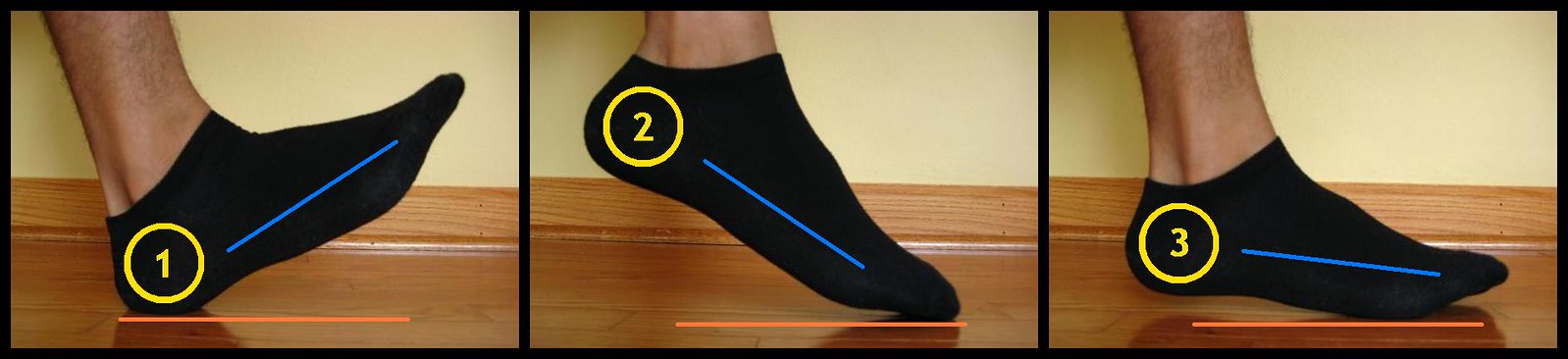
- This is a very subtle detail. The foot should be close to parallel when making contact with the ground. It has a slight down tilt, plantarflexion, to it. Look at this diagram,

Click to enlarge
(Trust me, you should)

The blue line is the angle of the foot and the orange line is the ground. Starting from the left, let's discuss each image.
  1. A heel strike is the most common action you'll see. This isn't necessarily bad but I haven't seen it contribute to a better lunge.
  2. Here is an exaggeration of the down tilt. You end up landing on the very front end.
  3. In the far right illustration the foot is almost parallel to the floor. It's similar to an airplane landing on a runway. The nose of the plane is pointed down enough that it's able to make a light impact on the ground.

    Here the foot is angled down a little bit. It can better absorb the shock of impact and get a firm holding underneath it.
Plant the Foot SOFTLY
- Lower the foot while attempting to make almost no noise. Plant it as gently and softly as possible. Let your body sink down on your heel. It will ensure your torso remains upright while you keep your balance.
Reverse Directions
- After you've lunged down, push through your heel to come straight UP. Then you can bring your foot back. Only return to a start after you've stood up. It becomes much more difficult to do if you're still in a knee flexed position.
Now what if you're having trouble despite using these cues? Practice with your bodyweight and hold each position for a few seconds. Work on stepping out and getting accustomed to the split stance. From there lower yourself a few inches, pause, stand, and repeat. Go lower each week then start with low reps. When you get the hang of it, add dumbbells.

As for programming them into a workout there aren't any rules to follow. I find they place nicely after a heavy compound movement like squats. A light set or two of 5-8 reps is enough to elicit a positive training effect. Ultimately the training parameters - and variation - are up to you.

One thing is certain: Don't neglect your legs by avoiding lunges. They're a very important exercise.
Further reading,

Thursday, May 17, 2012

Picking Your Shoes & Socks

What's your pick?

In strength training a person doesn't need much gear to lift. Shoes, socks, and that's about it. Even those aren't entirely necessary in a home gym. When competing, assistive equipment becomes an additional option. This includes belts, straps, suits, heeled shoes, and chalk.

But shoes and socks are usually glossed over by a trainee. There are a few nuances you should know about to maximize the comfort of your feet.
Socks
  • I like my socks like my shoes - very thin. Thick socks muffle your foot's ability to feel around in the shoe. It's similar to wearing overly supportive shoes where you're unable to feel the ground.
  • Make sure your socks breathe well. Feet get hot in shoes as is but the wrong socks can make your feet exceptionally sweaty.
  • Thin socks are great but not if they are constantly shifting around. They should conform well to your feet.
  • Long socks are often recommended for deadlifts and floor pulls. They protect the shins from the bar scraping them. This is actually a technical error. It can be the result of employing the back too early or just trying too hard to keep the bar close.

    Whatever the reason may be it creates friction and slows down the pull. Long socks reduce the problem but they don't eliminate it. Practice with short cut socks to ensure you're not scraping your shins.
  • Currently I use low cut Hanes socks. The elastic might be too low for some people as they can go into the shoe and slip off the back of the foot. If that's the case choose ankle socks such as these. (I'm not recommending Hanes. They're examples.)
Shoes
  • I say no shoe is the best shoe. However due to hygiene and safety issues that never sits well with gym staffs.
  • Since going barefoot isn't always a choice choose a thin minimal support shoe. It should be able to bend in half, twist, and be very flexible.
  • A good shoe will allow you to feel varying terrains. This is most noticeable when stepping on small rocks.
  • Secondary characteristics to consider are price and style. Some shoes are fashionable enough that they can double for casual wear.

My shoe choices
Left: Tai Chi's by Asics / Right: Martial Arts Slippers

  • BirthdayShoes.com is an excellent site for all things regarding minimal shoes. Use it to browse different shoes and their reviews.
Squats
  • Squat are another issue when determining your shoe.
  • Because ankle mobility, specifically dorsiflexion, is limited by genetics squat depth will stop at a certain point. Go pass that point and the chances are your form will be compromised.

    Toes go up [dorsiflexion],
    toes go down [plantarflexion]
    .
  • The elevated heel on weightlifting shoes reduces this problem and allows for deeper squats with a more upright torso.
  • How necessary is the heel? It depends on the lifter and is wholly up to them. Squats become easier but they can be done completely fine barefoot.

    I'd say front squats are the exception to this. In front squats you want your torso to stay as vertical as possible. Weightlifting shoes do a great job at accomplishing this.
  • If you feel you would benefit from a weightlifting shoe, check out WLShoes.com. The site reviews many of the weightlifting shoes currently on the market.
Picking the right socks and shoes for yourself isn't too hard a topic. Use the above information to narrow down what fits your preferences and see how it feels.

If you like your choice and it feels good when you lift that's all that matters.
Creative Commons License
Niel Patel's Blog by Niel K. Patel is licensed under a
Creative Commons Attribution-NonCommercial-ShareAlike 3.0 Unported License.